

The Georgia D-Visa is a long-stay immigration visa for foreigners who want to work, study, invest, or live in Georgia for more than 90 days. It comes in several subcategories – D1 for employment, D2 for students, D3 for researchers, and D5 for investors. Unlike the short-stay eVisa or visa-free entry, the D-Visa is the legal gateway to long-term residence and is a prerequisite for obtaining a Georgian residence permit.
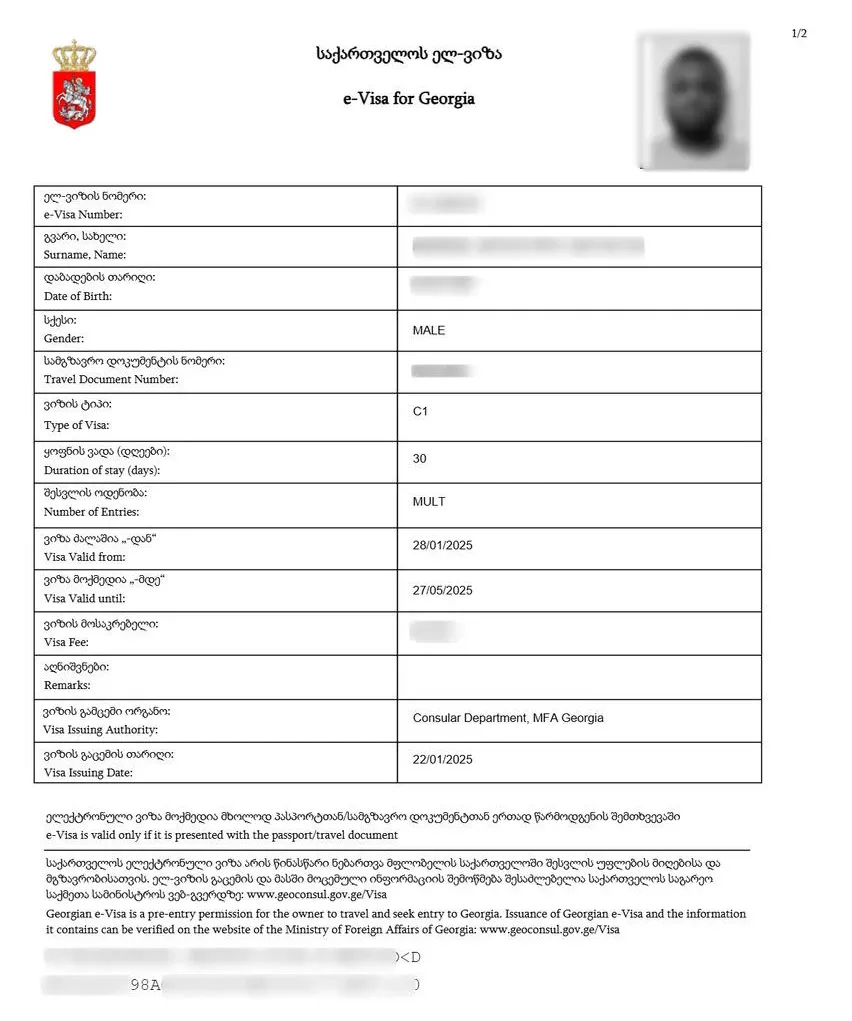
If you plan to stay in Georgia beyond the 90-day tourist limit, the D-Visa is mandatory. This guide covers every D-Visa subtype, the requirements for each, the application process, fees, and how to transition from a D-Visa to a residence permit.
What Is the Georgia D-Visa?
The D-Visa (also called the immigration visa) is issued by the Georgian Ministry of Foreign Affairs through its embassies and consulates abroad. It is designed for foreign nationals whose purpose of stay exceeds what a tourist visa or eVisa allows.
Unlike the short-stay C-Visa or the eVisa (which max out at 90 days), the D-Visa authorizes stays of up to one year. It is the mandatory first step for anyone who wants to obtain a Georgian residence permit.
Key characteristics:
- Duration: Up to 90 days per entry, but issued for the purpose of obtaining a residence permit
- Entries: Usually multiple-entry
- Purpose: Long-term work, study, research, investment, or family reunification
- Application method: At a Georgian embassy or consulate (not available online)
- Fee: Approximately $50-100 USD depending on the subtype and embassy
For a general overview of all visa categories, see our guide to Georgia visa types.
Georgia D-Visa Subtypes Explained
Georgia’s D-Visa is divided into several subcategories, each tailored to a specific purpose of stay. Understanding which subtype applies to your situation is critical, as the documents and eligibility requirements differ.
| Subtype | Purpose | Typical Duration | Key Requirement |
|---|---|---|---|
| D1 | Employment | Up to 1 year | Employment contract with Georgian employer |
| D2 | Education | Duration of studies | Acceptance letter from accredited institution |
| D3 | Research / Training / Cultural exchange | Up to 1 year | Invitation from host institution |
| D4 | Family reunification | Up to 1 year | Proof of family relationship with Georgian resident |
| D5 | Investment | Up to 1 year | Proof of qualifying investment in Georgia |
Each subtype has distinct documentation requirements, but all share the same basic application framework: you must apply in person at a Georgian diplomatic mission, provide biometric data, and demonstrate the purpose of your stay with supporting documents.
D1 Visa – Work Visa
The D1 visa is the most common D-Visa subtype. It is issued to foreign nationals who have a confirmed job offer or employment contract with a company registered in Georgia.
Requirements:
- Valid passport with at least 6 months remaining validity
- Employment contract or official job offer letter from a Georgian employer
- Completed application form
- Passport-sized photographs (3.5 x 4.5 cm)
- Proof of accommodation in Georgia (rental agreement or employer-provided housing)
- Visa fee payment
Important: The D1 visa alone does not authorize you to work. After arriving in Georgia, you must apply for a residence permit at the Public Service Hall. The D1 visa serves as the entry document that makes the residence permit application possible.
The D1 visa is initially valid for one year and can be renewed. After five years of continuous legal residence, you may be eligible to apply for permanent residency.
For information about short-term business visits that do not require a D-Visa, see our Georgia business visa guide.
D2 Visa – Student Visa
The D2 visa is for international students accepted into a Georgian educational institution – university, college, language school, or vocational training center that is accredited by the Georgian Ministry of Education.
Requirements:
- Valid passport (minimum 6 months validity)
- Official acceptance letter or enrollment confirmation from the institution
- Proof of financial means to cover tuition and living expenses
- Health insurance valid in Georgia
- Completed application form and passport photos
- Visa fee payment
The D2 visa is typically valid for the duration of the academic program. Students on a D2 visa may be permitted to work part-time, subject to conditions set by Georgian immigration law.
After arriving in Georgia, D2 holders must apply for a student residence permit at the Public Service Hall within 45 days.
D3 Visa – Research, Training, and Cultural Exchange
The D3 visa covers a broader range of long-term non-employment activities. It is commonly used by:
- Academic researchers and visiting scholars
- Participants in professional training programs
- Cultural exchange program participants
- Volunteers with registered organizations
- Interns at Georgian companies or institutions
Requirements:
- Valid passport
- Invitation letter or contract from the hosting Georgian organization
- Description of the research, training, or exchange program
- Proof of qualifications relevant to the program
- Health insurance
- Visa fee payment
The D3 visa is valid for up to one year and can be extended if the program continues.
D4 Visa – Family Reunification
The D4 visa allows close family members of Georgian citizens or residence permit holders to join their relatives in Georgia. Eligible family relationships include:
- Spouse of a Georgian citizen or resident
- Minor children of a Georgian citizen or resident
- Dependent parents of a Georgian citizen or resident
Requirements:
- Valid passport
- Proof of family relationship (marriage certificate, birth certificate)
- Documents proving the sponsor’s Georgian citizenship or residence status
- Proof of accommodation
- Visa fee payment
The D4 visa leads to a family reunification residence permit, which is typically valid for one year and renewable.
D5 Visa – Investment Visa
The D5 visa is designed for foreign investors who plan to make a significant economic contribution to Georgia. This can take several forms:
- Starting or acquiring a business in Georgia
- Purchasing real estate above a specified threshold
- Investing in Georgian government bonds
- Making a capital investment in a Georgian enterprise
Requirements:
- Valid passport
- Business plan or proof of investment
- Documentation showing the investment meets the minimum threshold
- Proof of the source of funds
- Health insurance
- Visa fee payment
The D5 visa can lead to a short-term residence permit, and depending on the investment amount and duration, may eventually qualify you for permanent residency or even Georgian citizenship.
D-Visa Application Process
All D-Visa applications must be submitted in person at a Georgian embassy or consulate in your home country or country of legal residence. The online eVisa portal does not handle D-Visa applications.
Step-by-step process:
- Identify your D-Visa subtype – Determine which category (D1-D5) matches your purpose of stay.
- Gather required documents – Each subtype has specific document requirements. Ensure all documents are translated into Georgian or English and notarized if required.
- Book an appointment – Contact the nearest Georgian embassy or consulate to schedule your application submission.
- Submit your application – Attend the appointment in person. You will submit documents, provide biometric data (fingerprints and photo), and pay the visa fee.
- Wait for processing – Standard processing takes 10-30 working days depending on the embassy and the completeness of your application.
- Receive your visa – If approved, the D-Visa sticker is placed in your passport.
- Travel to Georgia – Enter Georgia using the D-Visa.
- Apply for a residence permit – Within 45 days of arrival, visit the Public Service Hall to apply for your residence permit.
Note: Not all countries have a Georgian embassy. If there is no Georgian diplomatic mission in your country, you may need to apply at the nearest embassy in a neighboring country or contact the Georgian Ministry of Foreign Affairs for alternative arrangements.
D-Visa Fees
The D-Visa fee varies by subtype and the embassy where you apply. The following are approximate ranges:
| Processing Type | Fee (USD) | Processing Time |
|---|---|---|
| Standard | $50-80 | 10-30 working days |
| Expedited (where available) | $100-150 | 3-10 working days |
Fees are typically paid in the local currency equivalent at the time of application. Payment methods vary by embassy – some accept cash only, others accept cards or bank transfers.
Important: The D-Visa fee is non-refundable, even if your application is rejected. Make sure all your documents are complete and accurate before submitting.
For comparison with other visa types, see our Georgia eVisa fee guide.
D-Visa vs Other Georgia Visa Options
Understanding when you need a D-Visa versus another visa type saves time and money.
| Visa Type | Maximum Stay | Purpose | Application Method |
|---|---|---|---|
| Visa-free entry | Up to 1 year | Tourism, short business | Border (no application needed) |
| eVisa | 30-90 days | Tourism, short business, medical | Online (evisa.gov.ge) |
| C-Visa | Up to 90 days | Tourism, business (non-eVisa eligible countries) | Embassy/consulate |
| D-Visa | Up to 1 year (residence permit required) | Work, study, investment, family | Embassy/consulate |
Key distinction: Even citizens of visa-free countries (who can stay up to one year without a visa) need a D-Visa if they plan to work, study, or invest in Georgia. Visa-free entry does not grant work authorization.
If you only need a short visit, the eVisa or visa-free entry may be sufficient. Check our Georgia eVisa guide for details on the simpler online process.
From D-Visa to Residence Permit
The D-Visa is not the final step – it is the entry key that allows you to apply for a Georgian residence permit. Here is how the transition works:
- Enter Georgia on your D-Visa
- Visit the Public Service Hall (House of Justice) within 45 days of arrival
- Submit your residence permit application with supporting documents specific to your D-Visa subtype
- Receive a temporary residence card – processing typically takes 30 days
- Your residence permit is valid for one year (renewable) for most categories
The residence permit allows you to live and (depending on the type) work in Georgia legally. It also gives you access to Georgian banking, healthcare, and other services that require legal resident status.
After five years of continuous legal residence, you may apply for permanent residency. After ten years, Georgian citizenship may be possible, subject to additional requirements including language proficiency.
Tips for a Successful D-Visa Application
-
Start early. The D-Visa process takes 10-30 working days for processing alone, plus time to gather and prepare documents. Begin at least 2-3 months before your planned travel date.
-
Get documents apostilled. Documents issued abroad (diplomas, marriage certificates, police clearances) often need to be apostilled or legalized for use in Georgia.
-
Translate documents properly. All foreign-language documents must be translated into Georgian by a certified translator. Some embassies accept English translations.
-
Verify with the specific embassy. Requirements can vary slightly between Georgian embassies. Contact the embassy where you plan to apply to confirm exact requirements.
-
Keep copies of everything. Make photocopies and digital scans of all submitted documents. You will need many of the same documents again when applying for your residence permit.
-
Ensure passport validity. Your passport must be valid for at least 6 months beyond your planned entry date. If your passport expires soon, renew it before applying.
-
Prepare proof of funds. For most D-Visa subtypes, you need to show you can support yourself financially in Georgia. Bank statements from the last 3-6 months are typically required.
FAQs About the Georgia D-Visa
What is the difference between a D-Visa and an eVisa for Georgia?
The eVisa is a short-stay electronic visa for tourism or business visits of 30-90 days, applied for online. The D-Visa is a long-stay immigration visa for work, study, or investment, applied for at a Georgian embassy. If you plan to stay longer than 90 days or want to work in Georgia, you need a D-Visa.
Can I apply for a Georgia D-Visa online?
No. The D-Visa must be applied for in person at a Georgian embassy or consulate. The online eVisa portal only handles short-stay tourist and business visas. You need to visit a Georgian diplomatic mission with your documents and provide biometric data.
How long does it take to get a Georgia D-Visa?
Standard processing takes 10-30 working days after submission. Some embassies offer expedited processing for an additional fee, which can reduce the time to 3-10 working days. Processing times vary by embassy and the completeness of your application.
Can I work in Georgia with just a D-Visa?
The D-Visa (specifically the D1 subtype) allows you to enter Georgia for the purpose of employment, but you must also obtain a residence permit to legally work. Apply for your residence permit at the Public Service Hall within 45 days of arrival.
Do I need a D-Visa if I am from a visa-free country?
If you only plan to visit Georgia as a tourist, no – citizens of visa-free countries can stay up to one year without any visa. However, if you plan to work, study, or invest in Georgia, you need a D-Visa regardless of your nationality. Visa-free entry does not authorize employment.
How much does the Georgia D-Visa cost?
The D-Visa fee ranges from approximately $50 to $150 USD depending on the subtype and whether you use standard or expedited processing. Fees vary by embassy and are paid in the local currency equivalent. The fee is non-refundable.
Can I extend my D-Visa while in Georgia?
The D-Visa itself cannot be extended. However, if you applied for and received a residence permit, the residence permit is renewable annually. You must start the residence permit process within 45 days of entering Georgia on your D-Visa.
What happens if my D-Visa application is rejected?
If your application is rejected, you will receive a written reason. You can reapply after addressing the issues cited in the rejection. The visa fee is not refunded. Common reasons for rejection include incomplete documents, insufficient proof of purpose, or failure to meet financial requirements.
Can I bring my family to Georgia on a D-Visa?
Your spouse and minor children can apply for a D4 (family reunification) visa to join you in Georgia. You will need to prove the family relationship and demonstrate that you have accommodation and financial means to support them.
Is the Georgia D-Visa the same as a residence permit?
No. The D-Visa is an entry visa that allows you to travel to Georgia for a long-term purpose. The residence permit is a separate document obtained after arrival that authorizes you to live and work in Georgia. The D-Visa is the prerequisite for the residence permit application.