

Georgia offers a range of visa options depending on your nationality, purpose of visit, and length of stay. Whether you are coming for a short holiday, a business meeting, or long-term work, understanding the different Georgia visa types helps you choose the right one and avoid delays at the border.
Overview of Georgia’s Visa System
Georgia’s visa framework is managed by the Ministry of Foreign Affairs and operates through several channels. Citizens of around 90 countries can enter without any visa at all. Others can apply online for an electronic visa (eVisa), visit a Georgian embassy for a consular visa (C-Visa), or obtain a long-stay immigration visa (D-Visa) for work, study, or investment purposes.
Each visa type has its own eligibility rules, duration limits, and application procedures. This guide walks through every category so you can identify which Georgia visa matches your travel plans.
Visa-Free Entry
Georgia maintains one of the most generous visa-free regimes in the region. Citizens of all EU member states, the United States, Canada, Australia, Japan, South Korea, Israel, Turkey, and dozens of other nations can enter Georgia without a visa and stay for up to one full year.
If you hold a passport from a visa-free country, you do not need to apply for any visa in advance. Simply present a valid passport at the border. However, visa-free entry does not grant the right to work – for employment you need a D-Visa.
For the full list of exempt nationalities, see the Georgia visa-free countries guide.
Georgia eVisa (Short-Stay Electronic Visa)
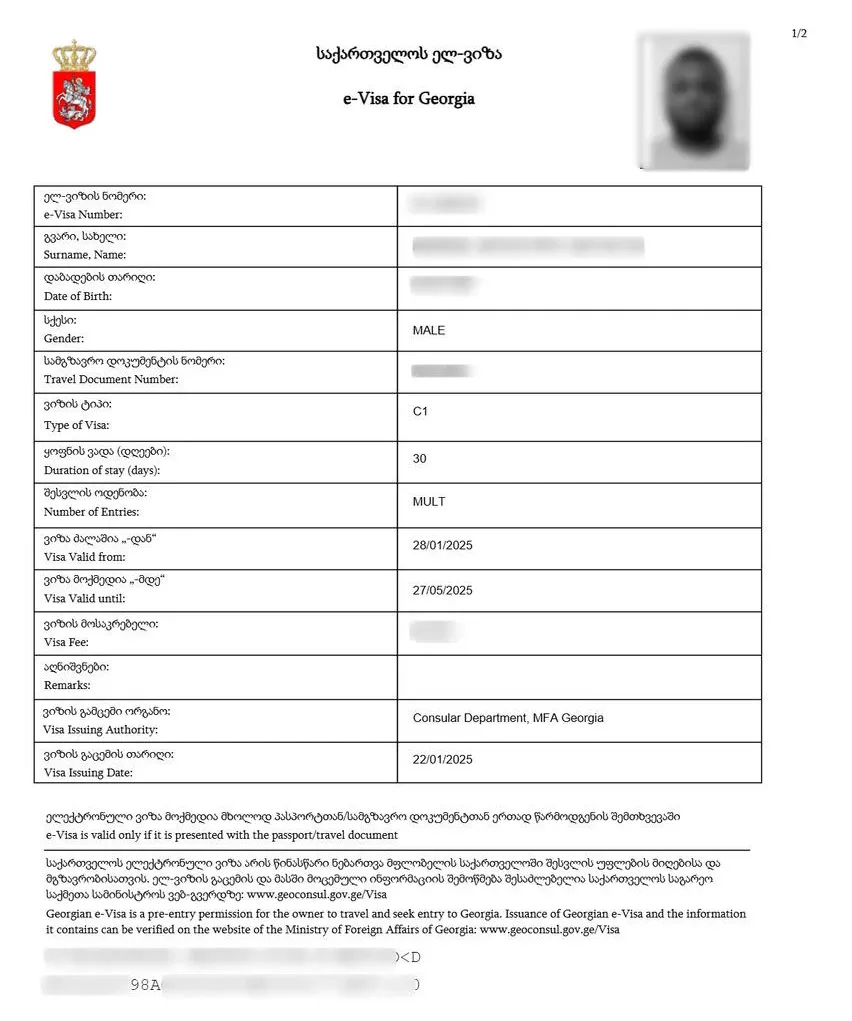
The Georgia eVisa is an online visa available to citizens of countries that are not visa-free but are eligible for electronic processing. It is the most convenient option for short visits and can be applied for entirely from home.
Key details:
- Duration: 30 days (single entry) or 90 days (multiple entry) within a 180-day period
- Purpose: Tourism, visiting family, business meetings, medical treatment
- Processing time: Typically 3-5 working days
- Application: Online through the official eVisa portal
Not all nationalities qualify for the eVisa. If your country is not on the eVisa-eligible list, you must apply through an embassy for a C-Visa instead.
For a step-by-step walkthrough of the online process, visit the Georgia eVisa application page.
Georgia C-Visa (Consular/Visitor Visa)
The C-Visa, also called the consular visa, is issued through Georgian embassies and consulates abroad. It is required for citizens of countries that are neither visa-free nor eVisa-eligible.
To apply, you typically need:
- A completed application form
- A valid passport (at least 6 months remaining validity)
- Passport-sized photos
- Proof of accommodation and return travel
- Evidence of sufficient funds
Processing times vary by embassy but usually take 5-10 working days. The C-Visa is generally issued for short stays of up to 90 days.
Georgia Transit Visa
If you are passing through Georgia on your way to another destination and are not eligible for visa-free entry, you may need a transit visa. The Georgia transit visa allows a stay of up to 5 days and requires proof of onward travel, such as a confirmed flight ticket to your final destination.
Transit visas are issued at Georgian embassies or, in some cases, at border crossings. They cannot be extended or converted into other visa types while in Georgia.
Georgia D-Visa (Immigration/Long-Stay Visa)
The D-Visa is Georgia’s long-stay immigration visa. It is intended for people who plan to live, work, study, or invest in Georgia for more than 90 days. The D-Visa comes in several subcategories, each with its own requirements.
D1 – Work Visa
The D1 visa is for foreign nationals who have secured employment with a Georgian company. An employment contract or official job offer from a Georgian employer is required. The D1 visa is initially issued for one year and can be renewed. It also serves as the basis for obtaining a Georgian residence permit.
D2 – Student Visa
The D2 visa is for international students enrolled at an accredited Georgian educational institution. You need an official acceptance letter from the university or school. This visa is valid for the duration of your academic program and allows part-time work under certain conditions.
D3 – Study/Work/Research Visa
The D3 visa covers a broader range of long-term activities, including academic research, professional training, and cultural exchange programs. It is often used by researchers, visiting scholars, and participants in bilateral exchange agreements.
D5 – Investment Visa
The D5 visa is designed for foreign investors making a qualifying investment in Georgia. This can include starting a business, purchasing real estate above a certain threshold, or investing in Georgian government bonds. The D5 visa can lead to permanent residency depending on the investment amount and duration.
For a detailed breakdown of long-stay visa options, see the Georgia D-Visa guide.
Georgia Business Visa
A Georgia business visa is intended for short-term business activities such as attending meetings, conferences, negotiations, or exploring investment opportunities. It does not authorize actual employment in Georgia.
For most nationalities, business visits fall under the eVisa or visa-free regime. However, if you are from a country that requires a visa and your purpose is business-related, you may apply for a business eVisa or a C-Visa with a business invitation letter from a Georgian company.
Short-term business visitors typically stay for up to 30 days. For longer business stays, a D-Visa may be required.
Georgia Digital Nomad Visa
Georgia launched a digital nomad program called “Remotely from Georgia” to attract remote workers and freelancers. This program allows eligible applicants to live in Georgia for up to one year while working remotely for a foreign employer or running their own business outside Georgia.
Eligibility requirements include:
- Proof of remote employment or self-employment
- Minimum monthly income of $2,000 USD
- Valid health insurance
- Clean criminal record
The digital nomad visa does not permit employment with a Georgian company. It is specifically for those earning income from abroad.
Comparison Table: All Georgia Visa Types
| Visa Type | Duration | Eligible Countries | Application Method | Purpose |
|---|---|---|---|---|
| Visa-Free | Up to 1 year | ~90 countries | No application needed | Tourism, short visits |
| eVisa | 30 or 90 days | eVisa-eligible list | Online portal | Tourism, business, medical |
| C-Visa | Up to 90 days | Non-eVisa countries | Embassy/consulate | Tourism, business, transit |
| Transit Visa | Up to 5 days | Non-visa-free countries | Embassy or border | Passing through Georgia |
| D1 Work Visa | 1 year (renewable) | All countries | Embassy + employer contract | Employment in Georgia |
| D2 Student Visa | Duration of study | All countries | Embassy + acceptance letter | Study at Georgian institution |
| D3 Research Visa | Varies | All countries | Embassy + program letter | Research, training, exchange |
| D5 Investment Visa | 1 year (renewable) | All countries | Embassy + investment proof | Business investment |
| Digital Nomad | Up to 1 year | Select countries | Online application | Remote work from abroad |
Which Georgia Visa Type Is Right for You?
Choosing the right visa depends on three factors: your nationality, your purpose of travel, and how long you plan to stay.
- Short holiday or tourism: Check if your country is visa-free. If not, apply for an eVisa online.
- Business meetings or conferences: Use the eVisa (business category) if eligible, or apply for a C-Visa with a business invitation.
- Employment in Georgia: You need a D1 work visa with a signed employment contract.
- Studying at a Georgian university: Apply for a D2 student visa after receiving your acceptance letter.
- Long-term investment or residency: The D5 investment visa is your path, with the possibility of permanent residency.
- Working remotely from Tbilisi: The digital nomad program lets you live in Georgia for up to one year.
If you are unsure which category applies, check the Georgia visa requirements for nationality-specific guidance.
Frequently Asked Questions
What are the different types of Georgian visas?
Georgia offers visa-free entry, eVisa (electronic short-stay visa), C-Visa (consular visa), transit visa, D-Visa (long-stay immigration visa with subcategories D1 for work, D2 for study, D3 for research, and D5 for investment), and a digital nomad visa. The right type depends on your nationality and purpose of travel.
What is a D1 visa in Georgia?
The D1 visa is Georgia’s work visa for foreign nationals who have an employment contract with a Georgian employer. It is initially valid for one year and can be renewed. Holders of a D1 visa are eligible to apply for a Georgian residence permit.
Who is eligible for a Georgia eVisa?
Citizens of countries on Georgia’s eVisa-eligible list can apply online. This list includes many countries in Asia, Africa, and the Middle East that are not part of the visa-free regime. If your country is not on the list, you must apply through a Georgian embassy for a C-Visa instead.
Is a Georgia visa difficult to get?
Georgia visas are generally straightforward to obtain. The eVisa has a simple online application with a high approval rate. D-Visas require more documentation (employment contract, university acceptance, or investment proof) but are processed efficiently. The main challenge is ensuring you apply for the correct visa type for your situation.